
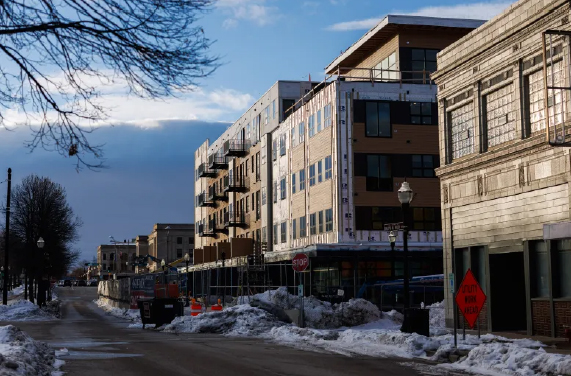
If an ambitious redevelopment plan takes hold, investment totaling hundreds of millions of dollars could soon pour into Kenosha, potentially transforming its economy and skyline five years after the police shooting of Jacob Blake attracted worldwide attention to the small lakefront city in Wisconsin.
The city replaced a damaged strip mall with an affordably priced apartment complex soon after the 2020 civil unrest that followed the Blake shooting. But that was just one step in a decadeslong effort to revitalize what had been a Rust Belt city hit by factory shutdowns.
Kenosha breathed new life into once-empty manufacturing sites, recently breaking ground on high-end residential developments near the city’s harbor, part of a new, walkable downtown meant to attract thousands of residents. A high-tech hub for small manufacturers, other local businesses and entrepreneurs has also begun rising just west of downtown.
“We’ve reinvented ourselves a number of times,” said John Antaramian, who recently retired after serving as mayor for nearly 25 years. “We need more density downtown if Kenosha is to grow and thrive.”
Residents of this diverse, multiracial city of 100,000 about 65 miles north of Chicago said Kenosha should be known for much more than the events of 2020. It was one of the Midwest’s leading centers for automobile manufacturing until Chrysler abandoned its massive downtown plants starting in the 1980s, and today its picturesque harbor, beaches and many mom-and-pop stores draw thousands of summertime visitors.
Most residents also said they hope Antaramian’s vision comes true, with sparkling new apartments and public plazas filling a new downtown while high-paying jobs return in big numbers.
“I have voted for these projects because we have an opportunity to do development in the city’s center,” said Ald. Anthony Kennedy, 10th, one of three Black City Council members. “They are the best options we have.”
But the city’s latest reinvention still worries Kennedy and other residents. It’s tough now to afford housing and food, they said. And although the development blueprints look great, hundreds of new, expensive apartments and amenities could remake downtown into a place for the tourists and the affluent, pricing out struggling Kenoshans and leaving behind those who suffered most from the civil unrest.
Antaramian said it’s essential to transform downtown into a walkable community, and include many high-end apartments. A walkable downtown will be a mecca for young people sought after by employers, create more jobs and attract retailers, potentially including grocery stores. What he called “workforce housing,” meaning units affordable to those making 60% of area median income, will continue to be developed as the city economy grows.
“I think it’s important that when we do development that there’s a balance, but we do need high-end (apartments) because that’s going to help us with our tax base.”
Wake-up call
Concern about inequities in Kenosha became especially pronounced after the city had its brief time in the spotlight during the summer of George Floyd protests, and a wave of community activism followed, said Alvin Owens, owner of Regimen, who opened his barbershop on 52nd Street the day Blake was shot in August 2020.
There wasn’t much permanent property damage, but a commercial strip and other businesses near the intersection of 60th Street and 22nd Avenue in Uptown were set on fire and boarded up. Owens turned his shop into a community gathering space, a mini-townhall for everyone.
“It was a real wake-up call, and many discussions happened at the barbershop,” Owens said. “All eyes were on Uptown, and the community jumped in to support us.”
Kenosha is now quiet, but the shop still plays that role, its walls usually covered with flyers announcing meetings, training opportunities or resources for young people considering college.
Owens said he wants downtown and the harbor district redeveloped. And he appreciates that the city completed in late 2023 Uptown Lofts, a 71-unit workforce housing development with a children’s library on the ground floor, on the site of the damaged commercial strip, before launching the market-rate units now under construction near the harbor. But it may not be enough, he said.
“The children’s library is great, and our downtown is deserving of its accolades, but the numbers don’t lie, rent keeps going up, and a lot of our local businesses are gone and never reopened,” Owens said. “My vision for Kenosha is similar to everybody else, it has to grow, but it has to grow for everybody.”
In the neighborhood around Uptown Lofts, 43% of the population is Hispanic or Latino, 35% are white and 16% are Black, according to city planning documents. The median household income is about $27,000, far below the $64,000 for Kenosha as a whole.
Kenosha’s plan to develop a walkable community isn’t unusual, said Reagan Pratt, director of The Real Estate Center at DePaul University.
“Kenosha is one of about 50 places in the Midwest trying to do something like this,” he said. “It’s not all that different from what the Bears say they want to do in Arlington Heights, or (developer) Sterling Bay planned to do with Lincoln Yards. It’s wickedly difficult to pull off and people are always trying to figure out what’s the secret sauce and how do we make this successful? Kenosha is an interesting case, and I hope it works.”
The damage from the 2020 events wasn’t even Kenosha’s biggest challenge.
The city was for generations a huge automobile manufacturing center, but in 1988 Chrysler shuttered its plant, formerly run by American Motors Corp., that sat on the harbor in the heart of downtown, killing off thousands of jobs, Antaramian said. It shut down the Kenosha Engine Plant just west of downtown in 2010. Other large manufacturers, including American Brass, also shut their doors.
“When I first became mayor in the 1990s there were only three stores left downtown,” he said. “That’s when the harbor was a barren field all fenced off.”
Antaramian, who was mayor from 1992 to 2008 before retiring and then winning reelection in 2016, began transforming the harbor in the 1990s. Once lined with smokestacks and filled with cargo ships, it became a residential and tourist hub. The city planted new lakefront museums, including a Civil War museum, and launched the construction of hundreds of market-rate townhomes on the former Chrysler site. Several affordable properties were also created, including the 60-unit 5th Avenue Lofts and Residences at Library Park, which provides affordable and market-rate units in a reconstructed historic YMCA building.
The city also annexed thousands of acres of farmland to the west now home to many small manufacturers, distribution warehouses and suburban-style homes. When Antaramian returned to office in 2016, he was ready to help launch the next phase in Kenosha’s transformation.
Kenosha’s City Council approved in 2023 a far-reaching plan to fill in the rest of the former Chrysler land near the harbor with about 1,000 apartments, some condos, a new Veterans Memorial Park, a market hall, public plazas, a new city hall and potentially an office tower.
Another potential crown jewel for Kenosha is the plan to replace the 107-acre Chrysler plot west of downtown with the Kenosha Innovation Neighborhood, including a business incubator for local entrepreneurs. Plans for the so-called KIN neighborhood, approved in 2022, included bike paths, parks, community gathering spaces, restaurants, residences, retail and a new home for LakeView Technology Academy, a public STEM high school.
“The two things we need to keep young people in Kenosha are new employers and a great quality of life,” and the new harbor district and the KIN neighborhood.
The high school opened early this year, and in October, the next KIN building, a 64,000-square-foot, $25 million business incubator opened its doors. It’s about 25% occupied, and hosts several venture capital firms and startups, a biotech firm and several universities including the University of Wisconsin-Parkside and Carthage College, said KIN President Kelly Armstrong.
The state kicked in $14 million to support the center, said Sam Rikkers, chief operating officer of the Wisconsin Economic Development Corp.
“It makes (Kenosha) a more attractive place for large employers to take root,” he said. “It’s super exciting to see old manufacturing supplanted by new manufacturers.”
Anthony Davis, president of the Kenosha NAACP and a retired autoworker who spent 37 years with the city’s main plant, said the next generation will need KIN and its educational institutions to get essential training.
“You need an education; you can’t find jobs in this economy straight out of high school,” he said. “It’s going to make things better, but it will be different, and I still don’t think we will have the high-paying jobs like we had at Chrysler and American Brass.”
The city first chose a developer for the harborside mixed-use district soon after the 2020 civil unrest. That developer’s funding plan fell through, but Milwaukee-based developer Cobalt Partners was eager to step in and take over, said Scott Yauck, the company’s president. He’s confident Kenosha’s new harbor district will attract thousands of new residents who want to live near the lake, and best of all, his company has a huge expanse of land available.
“You’ve got this void of nine blocks right in the center of downtown, and I can’t think of another city like that,” he said. “So our vision is if you bring in a critical mass of residents and stitch together the two halves of downtown, that will create a lot of vibrancy.”
Cobalt will complete in January the first building, a 158-unit apartment tower called The Karrick. All units are market-rate and listed for between $1,500 and $2,729 a month. The company will likely launch the second building, with about 210 units, by the second quarter of 2026. Yauck said the full harbor build-out could take 10 years, cost more than $600 million and create around 1,100 units.
Jolt of energy
Michael Kopper, CEO of Centrisys, a Kenosha-based manufacturer of high-speed centrifuges, said the city’s new downtown could eventually help recruit new workers. Kopper started his company in the 1980s out of a garage in Libertyville, Illinois, and moved to Kenosha in 1999 when it had 15 employees. It now employs 170 and occupies four buildings out west near the I-94 expressway.
“Some of our employees have little farms way out in the countryside, but a new downtown will get different kinds of people to move to Kenosha,” Kopper said. “We need young people to move here and most prefer living in apartments. We’re only 3 or 4 miles from downtown, so they could even ride their bikes here.”
Kevin Ervin, co-owner of the nearly century-old Frank’s Diner in downtown Kenosha, said the downtown area has improved a great deal since he and his wife, Julie Rittmiller, bought Frank’s 15 years ago. Big department store brands had left, but over time locally owned shops occupied most retail spaces, he said, and a built-out harbor district should bring an additional jolt of energy.
Jastrom said even the available affordable housing like Uptown Lofts, where two-bedroom apartments were advertised for about $1,200 per month, may not be enough to keep her in Kenosha.
“I can’t afford it,” she said. “When I lived in bigger cities, there were simply many more opportunities and money.”
Ald. Kennedy, who works as a driver and receives a small stipend as a City Council member, said he’s also feeling a cost-of-living squeeze.
“I’m getting priced out,” he said. “I’ve always said we’re a blue-collar, shot-and-beer kind of town, but we’re becoming more of a white wine and spritzer town.”
Two-bedroom apartments in Kenosha typically rent for between $1,500 and $1,900, and that can be very difficult for schoolteachers to afford, he added. And people with lower incomes may feel an even greater pinch if new neighborhoods like the KIN further raise housing prices.
“That’s something I don’t want to see in Kenosha, but it’s hard to prevent the market from doing what it wants to do,” he said. “That’s why we as municipal leaders need to step in and do more. Overall, I like where Kenosha is going, but there are things we need to be concerned about.”
Kenosha Mayor David Bogdala, elected in 2024 to succeed Antaramian, said he’s committed to carrying forward his predecessor’s plans for both the harbor district and KIN, including the creation of more workforce housing, and the Uptown neighborhood should get its long-awaited grocery store in coming months when a local business owner opens a grocery in Uptown Lofts.
“We should be looking at higher-end (housing) and affordable and everything in between,” he said.
Owens said with so much development going forward, Kenosha may be getting too comfortable. He doesn’t want the city to forget about poverty or affordability. And since much of the organizing energy that surged through Uptown following 2020 has died down a bit, it might be time to bring it back.
“Uptown has gotten quiet,” he said. “I would be interested in gathering together some Uptown citizens to see what they have to say.”
Read more at the Chicago Tribune.