
Communities can make economic improvements by collaboratively building on their strengths.
Bruce Katz delivered that message Tuesday during a Business and Professional Coalition luncheon at the Carthage College Todd Wehr Center, 2001 Alford Park Drive.
Katz co-wrote the 2018 book “The New Localism: How Cities Can Thrive in the Age of Populism.”
He is co-founder of New Localism Associates, a consulting firm that helps cities plan and enact sustainable growth.
Katz is also a senior advisor to the National Housing Crisis Task Force. He has held senior roles at the Brookings Institution and the U.S. Department of Housing and Urban Development.
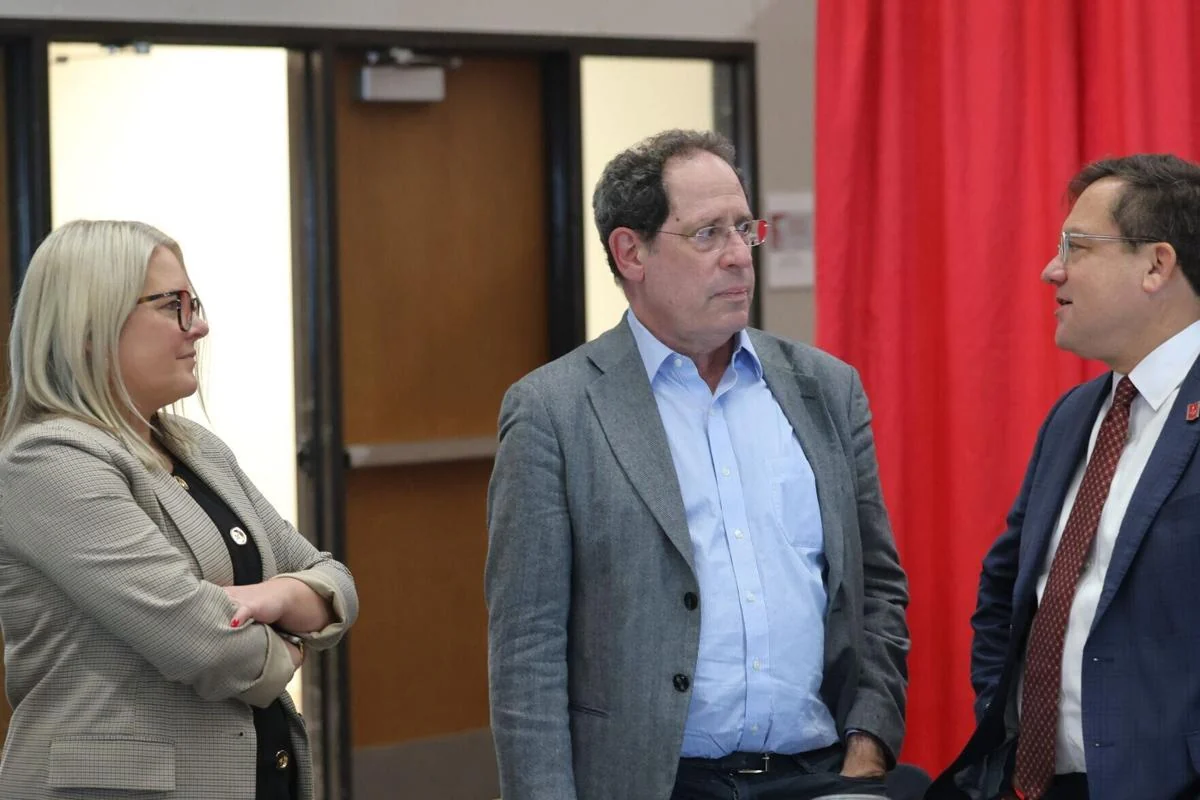
Bruce Katz said grassroots economic improvement is a “very complicated” issue, but one he believes can be addressed through cooperation.
‘From the ground up’
Katz believes the United States is experiencing an economic reshuffling shaped by the move from neoliberalism starting around 1980 to economic nationalism in recent years.
However, Katz said too much attention has been paid to national politics under the second Trump administration and that most action occurs state-wide and locally.
States and local municipalities need to work together to “lead the country from the ground up,” Katz said. “Power belongs to the problem-solvers, and those problem-solvers are disproportionately located in cities and metropolitan areas.”
Bruce Katz said the state legislature can provide resources, but figuring out and acting on regional identity must come from the people.
He said area decision-makers must identify their regional business identity and how to strengthen it.
“This is absolutely essential: read your economy correctly,” Katz said. “The question for southeastern Wisconsin is, ‘Who are you?’ Get past the noise, get past the politics. What is your role and your function in the Wisconsin economy, in the Midwest economy, in the U.S. economy and in the global economy?”
Katz said the state legislature can provide resources, but determining and acting on regional identity must come from the people.
“Organizing capital is the issue, so you can do that here,” Katz said. “You’ve got a group of people, literally in this room, from the financial community, from the university community, from manufacturing … the plan, the playbook, the ideas can generate from here.”
One way to answer is to determine the region’s relationship to Chicago and Milwaukee.
Kenosha and Racine are close and deeply connected to those metropolitan areas, which Katz believes is a strength.
Read more at the Kenosha News.